:max_bytes(150000):strip_icc():format(webp)/WWITrenches-58d2bf723df78c516207e744.jpg)
:max_bytes(150000):strip_icc():format(webp)/left_rail_image_history-58a22da068a0972917bfb5b7.png)
During trench warfare, opposing armies conduct battle, at a relatively close range, from a series of ditches dug into the ground. Trench warfare becomes necessary when two armies face a stalemate, with neither side able to advance and overtake the other. Although trench warfare has been employed since ancient times, it was used on an unprecedented scale on the Western Front during World War I.
Why Trench Warfare in WWI?
In the early weeks of the First World War (late in the summer of 1914), both German and French commanders anticipated a war that would involve a large amount of troop movement, as each side sought to gain or defend territory. The Germans initially swept through parts of Belgium and northeastern France, gaining territory along the way.
During the First Battle of the Marne in September 1914, the Germans were pushed back by Allied forces. They subsequently "dug in" to avoid losing any more ground. Unable to break through this line of defense, the Allies also began to dig protective trenches.
By October 1914, neither army could advance its position, mainly because war was being waged in a very different way than it had been during the 19th century. Forward-moving strategies such as head-on infantry attacks were no longer effective or feasible against modern weaponry such as machine guns and heavy artillery. This inability to move forward created the stalemate.
What began as a temporary strategy evolved into one of the main features of the war at the Western Front for the next four years.
Construction and Design of Trenches
Early trenches were little more than foxholes or ditches, intended to provide a measure of protection during short battles. As the stalemate continued, however, it became obvious that a more elaborate system was needed.
The first major trench lines were completed in November 1914. By the end of that year, they stretched 475 miles, starting at the North Sea, running through Belgium and northern France, and ending in the Swiss frontier.
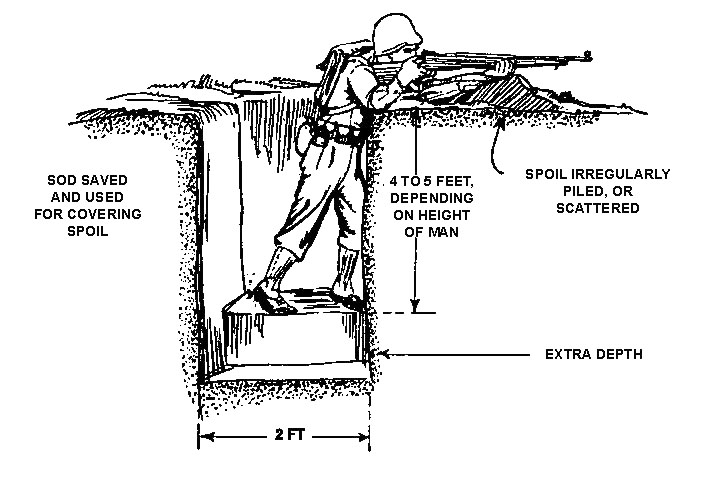
Although the specific construction of a trench was determined by the local terrain, most were built according to the same basic design. The front wall of the trench, known as the parapet, was about 10 feet high. Lined with sandbags from top to bottom, the parapet also featured 2 to 3 feet of sandbags stacked above ground level. These provided protection, but also obscured a soldier's view.
A ledge, known as the fire-step, was built into the lower part of the ditch and allowed a soldier to step up and see over the top (usually through a peephole between sandbags) when he was ready to fire his weapon. Periscopes and mirrors were also used to see above the sandbags.
The rear wall of the trench, known as the parados, was lined with sandbags as well, protecting against a rear assault. Because constant shelling and frequent rainfall could cause the trench walls to collapse, the walls were reinforced with sandbags, logs, and branches.
Trench Lines
Trenches were dug in a zigzag pattern so that if an enemy entered the trench, he could not fire straight down the line. A typical trench system included a line of three or four trenches: the front line (also called the outpost or the fire line), the support trench, and the reserve trench, all built parallel to one another and anywhere from 100 to 400 yards apart.
The main trench lines were connected by communicating trenches, allowing for the movement of messages, supplies, and soldiers and were lined with barbed wire. The space between the enemy lines was known as "No Man's Land." The space varied but averaged about 250 yards.
Some trenches contained dugouts below the level of the trench floor, often as deep as 20 or 30 feet. Most of these underground rooms were little more than crude cellars, but some, especially those farther back from the front, offered more conveniences, such as beds, furniture, and stoves.
The German dugouts were generally more sophisticated; one such dugout captured in the Somme Valley in 1916 was found to have toilets, electricity, ventilation, and even wallpaper.
Daily Routine in the Trenches
Routines varied among the different regions, nationalities, and individual platoons, but the groups shared many similarities.
Soldiers were regularly rotated through a basic sequence: fighting in the front line, followed by a period in the reserve or support line, then later, a brief rest period. (Those in reserve might be called upon to help the front line if needed.) Once the cycle was completed, it would begin anew. Among the men in the front line, sentry duty was assigned in rotations of two to three hours.
Each morning and evening, just before dawn and dusk, the troops participated in a "stand-to," during which men (on both sides) climbed up on the fire-step with rifle and bayonet at the ready. The stand-to served as preparation for a possible attack from the enemy at a time of day—dawn or dusk—when most of these attacks were likeliest to occur.
Following the stand-to, officers conducted an inspection of the men and their equipment. Breakfast was then served, at which time both sides (almost universally along the front) adopted a brief truce.
Most offensive maneuvers (aside from artillery shelling and sniping) were carried out in the dark when soldiers were able to climb out of the trenches clandestinely to conduct surveillance and carry out raids.
The relative quiet of the daylight hours allowed men to discharge their assigned duties during the day.
Maintaining the trenches required constant work: repair of shell-damaged walls, removal of standing water, the creation of new latrines, and the movement of supplies, among other vital jobs. Those spared from performing daily maintenance duties included specialists, such as stretcher-bearers, snipers, and machine-gunners.
During brief rest periods, soldiers were free to nap, read, or write letters home, before being assigned to another task.
Misery in the Mud
Life in the trenches was nightmarish, aside from the usual rigors of combat. Forces of nature posed as great a threat as the opposing army.
Heavy rainfall flooded trenches and created impassable, muddy conditions. The mud not only made it difficult to get from one place to another; it also had other, more dire consequences. Many times, soldiers became trapped in the thick, deep mud; unable to extricate themselves, they often drowned.
The pervading precipitation created other difficulties. Trench walls collapsed, rifles jammed, and soldiers fell victim to the much-dreaded "trench foot." Similar to frostbite, trench foot developed as a result of men being forced to stand in water for several hours, even days, without a chance to remove wet boots and socks. In extreme cases, gangrene would develop and a soldier's toes, or even his entire foot, would have to be amputated.
Unfortunately, heavy rains were not sufficient to wash away the filth and foul odor of human waste and decaying corpses. Not only did these unsanitary conditions contribute to the spread of disease, they also attracted an enemy despised by both sides—the lowly rat. Multitudes of rats shared the trenches with soldiers and, even more horrifying, they fed upon the remains of the dead. Soldiers shot them out of disgust and frustration, but the rats continued to multiply and thrived for the duration of the war.
Other vermin that plagued the troops included head and body lice, mites and scabies, and massive swarms of flies.
As terrible as the sights and smells were for the men to endure, the deafening noises that surrounded them during heavy shelling were terrifying. Amid a heavy barrage, dozens of shells per minute might land in the trench, causing ear-splitting (and deadly) explosions. Few men could remain calm under such circumstances; many suffered emotional breakdowns.
Night Patrols and Raids
Patrols and raids took place at night, under cover of darkness. For patrols, small groups of men crawled out of the trenches and inched their way into No Man's Land. Moving forward on elbows and knees toward the German trenches, they cut their way through the dense barbed wire.
Once the men reached the other side, their goal was to get close enough to gather information by eavesdropping or to detect activity in advance of an attack.
Raiding parties were much larger than patrols, encompassing about 30 soldiers. They, too, made their way to the German trenches, but their role was more confrontational.
Members of the raiding parties armed themselves with rifles, knives, and hand grenades. Smaller teams took on portions of the enemy trench, tossing in grenades, and killing any survivors with a rifle or bayonet. They also examined the bodies of dead German soldiers, searching for documents and evidence of name and rank.
Snipers, in addition to firing from the trenches, also operated from No Man's Land. They crept out at dawn, heavily camouflaged, to find cover before daylight. Adopting a trick from the Germans, British snipers hid inside "O.P." trees (observation posts). These dummy trees, constructed by army engineers, protected the snipers, allowing them to fire at unsuspecting enemy soldiers.
Despite these strategies, the nature of trench warfare made it almost impossible for either army to overtake the other. Attacking infantry was slowed down by the barbed wire and bombed-out terrain of No Man's Land, making the element of surprise unlikely. Later in the war, the Allies did succeed in breaking through German lines using the newly-invented tank.
Poison Gas Attacks
In April 1915, the Germans unleashed an especially sinister new weapon at Ypres in northwestern Belgium: poison gas. Hundreds of French soldiers, overcome by deadly chlorine gas, fell to the ground, choking, convulsing, and gasping for air. Victims died a slow, horrible death as their lungs filled with fluid.
The Allies began producing gas masks to protect their men from the deadly vapor, while at the same time adding poison gas to their arsenal of weapons.
By 1917, the box respirator became standard issue, but that did not keep either side from the continued use of chlorine gas and the equally-deadly mustard gas. The latter caused an even more prolonged death, taking up to five weeks to kill its victims.
Yet poison gas, as devastating as its effects were, did not prove to be a decisive factor in the war because of its unpredictable nature (it relied upon wind conditions) and the development of effective gas masks.
Shell Shock
Given the overwhelming conditions imposed by trench warfare, it is not surprising that hundreds of thousands of men fell victim to "shell shock."
Early in the war, the term referred to what was believed to be the result of an actual physical injury to the nervous system, brought about by exposure to constant shelling. Symptoms ranged from physical abnormalities (tics and tremors, impaired vision and hearing, and paralysis) to emotional manifestations (panic, anxiety, insomnia, and a near-catatonic state.)
When shell shock was later determined to be a psychological response to emotional trauma, men received little sympathy and were often accused of cowardice. Some shell-shocked soldiers who had fled their posts were even labeled deserters and were summarily shot by a firing squad.
By the end of the war, however, as cases of shell shock soared and came to include officers as well as enlisted men, the British military built several military hospitals devoted to caring for these men.
The Legacy of Trench Warfare
Due in part to the Allies' use of tanks in the last year of the war, the stalemate was finally broken. By the time the armistice was signed on November 11, 1918, an estimated 8.5 million men (on all fronts) had lost their lives in the so-called "war to end all wars." Yet many survivors who returned home would never be the same, whether their wounds were physical or emotional.
By the end of World War I, trench warfare had become the very symbol of futility; thus, it has been a tactic intentionally avoided by modern-day military strategists in favor of movement, surveillance, and airpower.
:max_bytes(150000):strip_icc():format(webp)/fall-of-the-berlin-wall-596687587-5ab906bc875db900376413b5.jpg)
:max_bytes(150000):strip_icc():format(webp)/italian-fascist-youth-2698633-59887c4faad52b0010e29e14.jpg)
:max_bytes(150000):strip_icc():format(webp)/Migrant_Mother_Nipomo_California_3334095096-37e37c052a0745ba9cf9fae3cc5f967b.jpg)
:max_bytes(150000):strip_icc():format(webp)/GettyImages-909627914-91f667c35b3743b99de7d342c444f01f.jpg)
:max_bytes(150000):strip_icc():format(webp)/Flappers1920s-58a346bd3df78c4758d56c59.jpg)
:max_bytes(150000):strip_icc():format(webp)/disneyland-3295337-58e7f1285f9b58ef7e68ee5d.jpg)
:max_bytes(150000):strip_icc():format(webp)/selma-to-montgomery-alabama-march-459534214-cc55e8e39a774951b38fb3c443299ad6.jpg)
:max_bytes(150000):strip_icc():format(webp)/GettyImages-185837254-58573e6b5f9b586e029b4ec0.jpg)
:max_bytes(150000):strip_icc():format(webp)/Lusitania-56a48c045f9b58b7d0d77ff4.jpg)
:max_bytes(150000):strip_icc():format(webp)/the-red-baron-poses-with-young-officers-55830596-5c9310eec9e77c00010a5d0d.jpg)
:max_bytes(150000):strip_icc():format(webp)/olympics1920-56a48df53df78cf77282f0ea.jpg)
:max_bytes(150000):strip_icc():format(webp)/infantry-running-with-tank-517403124-9a1629493a63457ba3d4c254beac2b49.jpg)
:max_bytes(150000):strip_icc():format(webp)/3281174-56a48d803df78cf77282f036.jpg)
:max_bytes(150000):strip_icc():format(webp)/wars-56a48c175f9b58b7d0d7804d.jpg)
:max_bytes(150000):strip_icc():format(webp)/redbaron2-56a48dfb5f9b58b7d0d7832a.jpg)
:max_bytes(150000):strip_icc():format(webp)/Emergency_hospital_during_Influenza_epidemic_Camp_Funston_Kansas_NCP_1603-5ad2699230371300370c75ea.jpg)